What makes an AI-First company?
AI is now part of everyday work. Employees use chat assistants like Claude and ChatGPT. Engineers use coding assistants. Teams across the business are automating repetitive tasks. Many companies now describe themselves as AI-first. That is where the gap begins.
Using AI and being AI-first are not the same thing. BCG found that roughly 60% of companies are still generating little measurable value from AI, while only 5% qualify as AI future-built organizations. Those leaders are already achieving 1.7 times higher revenue growth and 1.6 times higher EBIT margins than their peers.
Why the gap? BCG’s January 2026 Executive Perspective on AI value creation in private equity argues that deploying AI tools alone does not create meaningful value. Measurable impact requires organizations to redesign workflows, operating models, talent, and change management around AI. A separate study by AICPA, CIMA, and NC State University found that only about one-quarter of organizations report adequate AI-skilled talent, IT system readiness, or regulatory preparedness.
The question is not whether your teams are using AI. It is whether your organization is changing because of it.
The Spectrum Most Companies Misjudge
Most organizations measure AI maturity through usage. A more useful lens is a progression through four stages:
| AI-Curious | Teams experiment with AI occasionally, without systematic application. |
| AI-Assisted | Employees use AI to improve personal productivity. Workflows are largely unchanged. |
| AI-Enabled | Specific workflows or products incorporate AI in meaningful ways. |
| AI-First | The organisation restructures itself around AI-driven iteration, validation, and decision making. |
The gap between AI-enabled and AI-first is the one most organizations underestimate. AI-enabled organizations improve local productivity. AI-first organizations go further, redesigning workflows and planning cycles around the assumption that execution has become dramatically cheaper.
The question shifts from “Where can we use AI?” to “How should the company operate when execution is no longer the primary constraint?”
What Changes When a Company Becomes AI-First
Humans Move Up The Stack
As AI takes on more execution, human work shifts toward judgment, validation, and direction. The value of implementation declines. Deciding what to build, why it matters, and whether the output is trustworthy becomes the high-value work. The role does not disappear. It moves up.
Bottlenecks Move
When execution accelerates, the constraint shifts from output capacity to decision quality and review bandwidth. This is why many organizations see strong individual productivity gains but modest company-level impact. One part of the system speeds up while the rest stays the same. AI-first organizations redesign around the new bottleneck, not the old one.
Learning Becomes The Competitive Advantage
When execution is cheap, learning speed matters more. AI-first companies are not just building faster. They are learning faster, and that is where the durable advantage compounds.
What Practitioners Are Seeing
In a recent conversation on the AI-First Engineering podcast hosted within CPTOFracs, Tintash’s community of fractional CTOs and CPOs, Thanos Diacakis, a technology leader and software engineering coach with more than 25 years of experience, described how engineers have moved from reviewing every line of AI-generated code to directing agents across multiple projects, focusing on architecture, constraints, and outcomes.
In the right context, a skilled engineer can now ship dramatically more production-ready work than was previously possible. That engineer is no longer spending most of their time writing code. They are doing something harder: actual engineering. The code generation is delegated. The judgment and accountability remain human.
At Tintash, we have seen this pattern firsthand across client engagements: teams that redesign a workflow around AI from the ground up see durable gains, while teams that simply layer AI tools onto existing processes plateau quickly.
AI is a multiplier. And like any multiplier, it needs a capable hand directing it.
The AI-First Operating System
Operational maturity is a better indicator of AI-first status than tooling. The Sustainable Velocity Framework, presented by Diacakis, identifies four outcome dimensions: iteration, quality, complexity, and planning, supported by three levers: technology, process, and culture.
AI amplifies all four dimensions in both directions. Strong foundations get stronger. Weak ones break faster. As the framework states:
“The teams that benefit from AI are not the ones that adopt tools the fastest. They are the ones with the strongest systems underneath.”
Improvement comes from identifying the weakest dimension and applying the right lever, not from broad AI initiatives applied uniformly. The diagnostic below shows what each dimension looks like across the maturity spectrum.
AI-First Readiness: Where Does Your Organization Stand?
Score each dimension from 1 to 4. Sum your scores (range: 7 to 28) and find your tier below. The goal is not a number. It is to find your actual constraint.
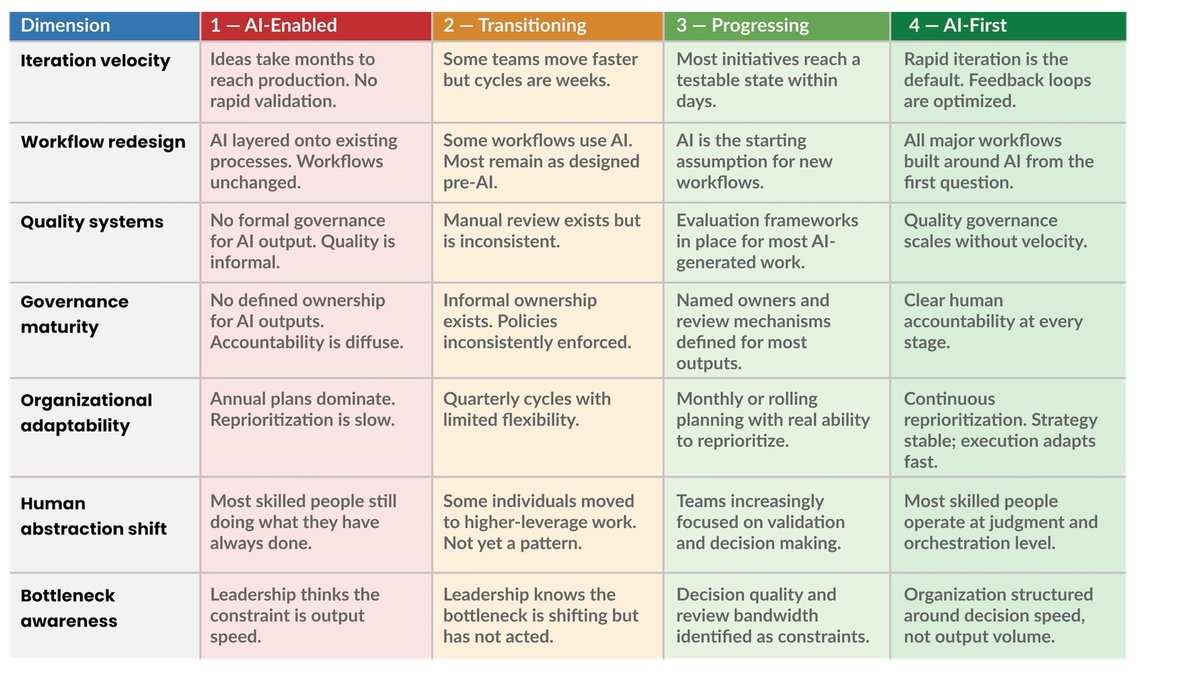
| AI-Enabled Score: 7-13 | AI-Transitioning Score: 14-20 | AI-First Score: 21-28 |
|---|---|---|
| Tools deployed but operating model unchanged. Focus: Rebuild one high-frequency workflow around AI from scratch. | Changes underway but AI capability not yet translating to business impact. Focus: Map one AI initiative to a financial metric. | Workflows rebuilt, bottleneck shifted to decision quality. Focus: Manage complexity actively. |
The Window is Closing Faster Than Most Leaders Think
In many software-led markets, the companies moving fastest are often those with the least to unlearn. A small founding team with AI-native workflows can often achieve output that previously required much larger teams, without the coordination overhead and inertia that slow larger organizations down.
Large organizations have real advantages: distribution, relationships, capital, data, and brand. But those advantages decay if the organization cannot iterate, cannot maintain quality at speed, and cannot match the agility that AI-native competitors treat as a given.
Among CEOs surveyed by BCG, roughly 70% are classified as “Pragmatists”: interested in AI but only willing to commit when they see clear value and low risk. The 15% BCG labels “Trailblazers” are already pulling away. The longer an organization stays in Pragmatist mode, the harder the catch-up becomes.
What AI-First Actually Requires
Being AI-first is a leadership challenge before a technology one.
It requires honesty about where your organization sits on the spectrum. Discipline to fix foundations before accelerating. Willingness to redesign workflows rather than retrofit them. And a culture where the human role shifts to a higher, more strategic level.
The organizations capturing real value from AI are not necessarily those that moved first. They moved with clarity: strong systems underneath, leadership at the right level of abstraction, and a clear-eyed view of what AI multiplies and what it cannot replace.
At Tintash, the Enterprise AI Studio is built around exactly this: contained, low-risk probes that map one workflow to one financial metric, with clear success criteria before anyone commits to scale. The diagnostic above is where that conversation starts.
The question worth sitting with is not “are we using AI?” Almost everyone is. The real question is: at which level of the spectrum are you operating, and is that good enough?
Useful Links
This article draws on insights from the AI-First Engineering podcast featuring Thanos Diacakis, technology leader, software engineering coach, and author of the Sustainable Velocity Framework, hosted within CPTOFracs, Tintash’s community of fractional CTOs and CPOs. Data is sourced from BCG’s The Widening AI Value Gap (September 2025, n=1,250 enterprises), BCG’s Executive Perspective: AI-First Companies Win the Future (January 2026), BCG AI Radar 2026 (January 2026, n=2,360 executives, including n=640 CEOs for CEO archetypes), and AICPA, CIMA, and NC State University’s Executive Perceptions of Artificial Intelligence Opportunities and Risks: A Global Analysis (February 2026, n=1,735 executives).