Enterprise AI for PE‑Backed Companies
What we do
We help PE-backed CXOs leverage AI in their organizations to increase operational efficiency and validate new revenue streams, with outcomes that show up in EBITDA and exit multiples.
How we do it
Leaders bring their AI hunches. Our forward-deployed engineers embed in their teams to run discovery, create proposals, and build what leadership approves, then support handoff or scale. Our remote teams are supported by co-located product and technology leadership.


Who we’ve worked with
Top-10 Megafundbacked portfolio company
Leading UScrypto exchange
4 Fortune 500sserved
12 unicornsand 170+ startups
We don’t scale AI until it reaches Workflow-User Fit
Workflow-User Fit (WUF) is the point where AI fits both the workflow it enters and the people who run it. It rarely happens on day one, so we iterate toward it. We discover and understand your workflows, automate them, gather real-world feedback, and keep refining until the fit is there.
Five stages of working together, planned around your business milestones
01AlignGoal, success measures and scope agreed
02DiscoverIdeas found, scored and ranked with you
Gate: first proof
03ProveA first version in users’ hands
Gate: scale-up
04ScaleWUF measured, Feedback taken, Workflow Added
Discover, Prove and Scale repeat for each new workflow
Gate: each quarter
05HandoffYour team runs and extends it
At each gate you decide whether to continue, so budget is committed one stage at a time.
Our Forward Deployed Pods embed with your team
Every engagement is run by a forward-deployed team: senior leaders close to your business, engineers inside your workflows, and hours that overlap with yours.
Colocated CTOsPeople who have run these workflows before, with a direct line to your leadership while the work happens.
Global FDEsEngineers who embed with your team until the workflow sticks, led by a core of 20 partners with 14+ years at the firm.
Cross-functional teamBusiness analysts, data specialists and engineers in one team, working to each department’s standards.
4+ hours of daily overlapWorking hours that overlap with yours every day, so decisions never wait overnight.
Every pod follows the same operating principles, from the first workflow to handoff.
Impact analysis firstKnock-on effects in connected systems are checked before each change.
ROI-led and measuredHighest-return work first, each tied to a success measure and tracked.
Built in your systemsYour existing tools, data and repositories. The code stays yours.
Engineering-gradeCode your CTO and engineering team will sign off on.
Embedded with youInside your organization, working alongside your people day to day.
Iterate more affordablyRun more experiments for the same budget, and keep the ones that show up in EBITDA.
Every stage runs within your security, governance and compliance rules.
Selected case studies
The Enterprise AI priorities we specialize in
Communities that bring experienced leaders and operators to the table
Our communities connect us with technology leaders and PE-backed operators who share practical lessons from building and adopting AI.
Fractional CTOs with the domain knowledge your workflow needs
When a workflow needs domain depth, we bring in a senior technology leader who has done this work before. They come from CPTOFracs and work alongside our forward-deployed engineers, with at least four hours of daily overlap.


Cybersecurity and AI risk

Digital engineering at enterprise scale

Engineering quality and delivery

AI strategy and product

Enterprise data and ML
PE Operators Table
Invite only. PE-backed operators only.
An invite-only community where operators at PE-backed companies share what worked with AI, what failed, and why. Only 7% of portfolio companies have reached enterprise-scale AI deployment (FTI, 2026 PE AI Radar). The table exists so operators can learn from peers who are further along.
Who it is for
- Operators, executives and CXOs at PE-backed companies of roughly $100M to $500M in revenue who own the AI-driven operational transformation
- Operating partners and value creation leads at the funds behind those companies
How the table works
- 01Monthly roundtablesSix to eight seats, one real problem worked through by people under the same pressure.
- 02Lightning talksTen to fifteen minutes. One operator, one story: what worked, what didn’t, and why.
- 03A running group between sessionsA private room to keep the conversation going after each roundtable.
Run by Mannan Amin, Co-Founder & President of Tintash. Chatham House rules apply, and vendors don’t pitch at the table, including Tintash.
Healthcare leaders and AI builders, sharing what actually works
An invite-only community focused on applying agentic AI in healthcare. Healthcare leaders and AI developers share real-world lessons on what works and what doesn’t, through roundtables, webinars and lightning talks. No sales, no fluff. Tintash powers it.

AI literacy and patient safety

Managing AI risk in clinical workflows

PHI, HIPAA and data handling

Measuring healthcare AI value

Scaling agentic automation

Predictive care and digital twins
Client testimonials
Home / Solutions / AI-Enabled Document Processing
AI-Enabled Document Processing
Extract, review and validate information across document-heavy workflows, with people in the loop and every decision auditable.
The problem we solve
Why this stalls inside most teams
Document-heavy work such as compliance checks, verification and regulatory research scales linearly with specialist time, across many formats and languages, and every decision has to stand up to audit.
Your teams are rightly focused on serving existing customers, which leaves little room to experiment. We work as the embedded team that tests new ideas and turns proven wins into systems your people own.
What we deliver
- Multi-agent extraction across document types and languages
- Deterministic rules, so every pass or fail decision is explainable
- A reviewer workflow with the extraction and rule trace attached
- A complete audit trail for enterprise compliance review
Case study
How we take it from hunch to production
See it in production
Models and tools
Built on a production AI stack
Claude first, with 20+ Claude Certified Architects on the team.
Other solutions
What workflow constraints are you facing?
Book a readiness workshopHome / Case Studies / Avetta
AI-Powered Document Verification for a Top 10 Megafund Portfolio Company
Tintash built a Claude-powered document verification engine for a global compliance company, significantly reducing supplier compliance verification time.
Client | Avetta (EQT-backed)
Business Problem
Avetta is the leader in intelligent work readiness across global supply chains - helping organizations verify the suppliers they rely on to operate safely, compliantly, and efficiently. Every day, suppliers submit a wide range of documentation, including insurance certificates, training records, certifications, and regulatory forms, that must be validated before work can begin.
As Avetta's global community continued to grow, so did the volume and complexity of supplier documentation. Supporting multiple document types, languages, and varying regulatory requirements across regions required a solution that could scale efficiently while maintaining the accuracy, transparency, and human oversight essential to its operations. To support this growth, Avetta partnered with Tintash to proactively modernize and scale its verification process while maintaining the rigorous compliance standards customers need.
Output by Tintash
Tintash built the Batch Verification Service, an AI-powered verification engine combining multi-agent document extraction, deterministic compliance rules, multilingual processing, and reviewer workflows with complete auditability.
Impact for Client
The Batch Verification Service enabled Avetta to scale document verification while maintaining the high level of accuracy its customers have come to expect. For example, Avetta achieved a reduction in per-document verification time - with 95% field-level extraction accuracy on text PDFs.
Client background
Founded in 2003 and backed since 2024 by EQT, one of Europe's largest private equity firms, Avetta is building the largest global community of hiring clients and suppliers that are Ready to Work. Its unified platform streamlines compliance, prequalification, safety and performance benchmarking in a single, integrated experience.
Trusted by over 130,000 businesses across more than 120 countries, Avetta blends AI-driven insights and human expertise to close risk gaps and strengthen supplier reliability so projects start on time, risks are managed proactively, and operations scale with certainty.
Operational challenge
Verifying supplier documentation at scale is one of the most operationally intensive parts of the business. As submission volumes increased across document types, languages, and regions, the legacy approach became harder to sustain efficiently. Scaling capacity depended heavily on specialist review, peak periods increased operational pressure and cost, and multilingual coverage created additional complexity.
The result was a verification operation that was expensive, challenging to scale, and increasingly difficult to keep aligned with Avetta's growth trajectory.
Output by Tintash
Tintash provided Forward Deployed Engineers (FDEs) who worked closely with Avetta's product and engineering teams to bring the company's vision for the Batch Verification Service (BVS) to life. Together, the teams built an end-to-end AI-powered document processing pipeline that removes the manual extraction and rule-checking burden from reviewers while keeping a human in the loop for exceptions and edge cases.
The solution was designed to:
- Streamline document processing across a wide range of submission types.
- Support multilingual verification workflows across regions.
- Improve consistency and transparency in verification outcomes.
- Maintain human review for exceptions and edge cases.
- Preserve auditability within the broader operating environment.
Capabilities and business impact
What the Batch Verification Service is capable of:
Significant Reductionin per-document verification time
Up to 4,500 hrsProjected savings per 100,000 document verifications
14 Document Types
6 LanguagesMultilingual verification supporting regulatory workflows across EMEA and North America.
6 LanguagesMultilingual verification supporting regulatory workflows across EMEA and North America.
95% (approx)field-level extraction accuracy on text PDFs
Up to 25 Concurrentdocument verifications processed in parallel
Home / Case Studies / onBeacon
From Design Reviews to AI-Native Product Intelligence
Built an AI-native, multi-agent product intelligence platform using Claude within a custom orchestration layer to analyzes UI designs, validates insights, generates prototypes, and delivers real-time, brand-aligned recommendations.
Client | onBeacon
Business Problem
OnBeacon needed to build an AI-first product that could turn slow, subjective design reviews into fast, actionable feedback.
Output by Tintash
Built an AI-native, multi-agent platform that analyzes UI designs, validates insights, and delivers real-time, brand-aligned recommendations.
Impact for Client
Reduced time from insight to action from weeks to minutes, drove 19K+ users with 30% MoM growth, and supported $1.3M pre-seed funding.
I have worked with some of the best AI talent in the world at companies like Siri and Apple. When it came to building an AI team for my own startup DesignPro (now onBeacon), I relied on Tintash to find me talent with excellent research, engineering and communication skills. I am beyond impressed with their talent pool and team's ability to do exceptional work at an affordable price.
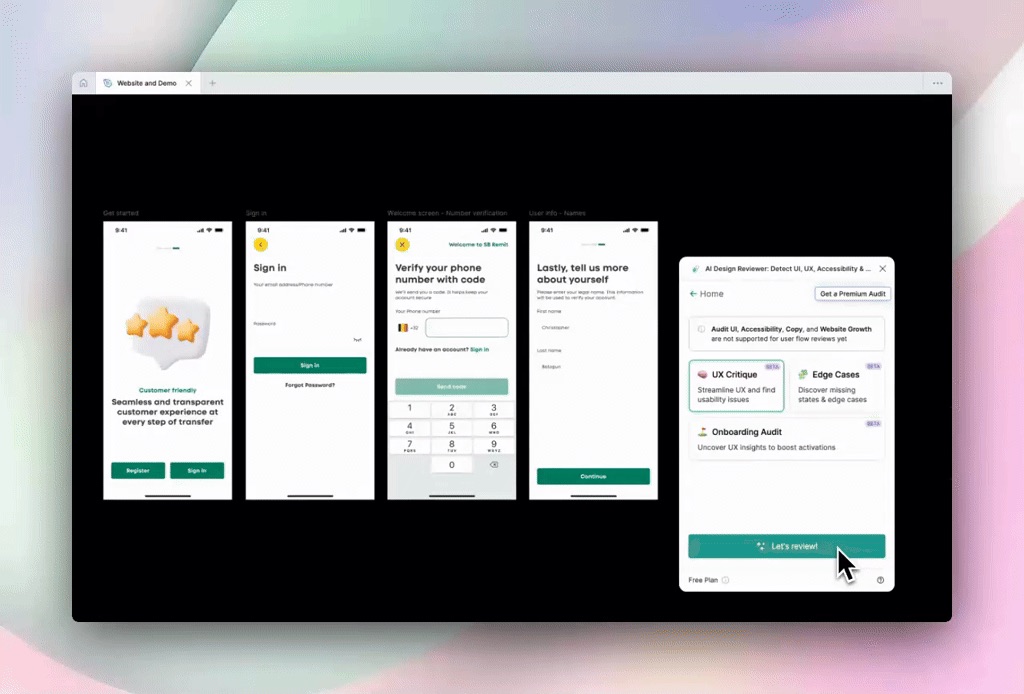
Client background and business problem
Design reviews were slow, inconsistent, and impossible to scale
Picture a typical design review before onBeacon. A product team opens a Figma file, shares a screen, and spends an hour going back and forth. One designer flags the visual hierarchy. Another disagrees. A third raises an accessibility concern that contradicts the first. The meeting ends with a list of feedback items, most of them subjective, some of them in conflict with each other. Then someone has to turn that into actual design changes. That process takes another week.
For fast-moving product teams, this was simply the norm. The quality of a design review depended entirely on who was in the room and how much time they had. There was no way to make the output consistent across reviewers, no mechanism to grow throughput without adding people, and no path from feedback to implementation that did not involve another round of meetings.
onBeacon set out to change that. The goal was a platform that could analyze any UI design in real time, surface structured evidence-backed findings, and go one step further by generating concrete prototypes showing teams exactly what a recommended change would look like applied to their actual work. Not abstract feedback. Something a designer could act on in the same session. They needed a technical partner who could own the architecture and build something production-ready from scratch.
How did Tintash deliver?
A production multi-agent architecture of 30-40 specialized agents, with Claude handling the most reasoning-intensive workloads
Tintash owned the system architecture, AI orchestration layer, model evaluation framework, backend implementation, and deployment infrastructure, building the platform from the ground up. The platform has been in continuous production use for two years, evolving through multiple generations of AI models. It has active users across a Figma plugin, Web Dashboard, and a managed service where onBeacon’s designers moderate AI-generated analysis for enterprise clients. Human reviewers remain in the loop for enterprise engagements, validating AI-generated recommendations before delivery to customers.
A multi-agent system at the foundation
The platform routes each design through a production multi-agent system composed of 30–40 specialized agents running in parallel. Each agent evaluates a specific dimension of quality: layout, typography, accessibility, CTA clarity, brand alignment, and other categories. This decomposition allows individual dimensions to be independently benchmarked, tuned, and upgraded without affecting the rest of the system. A resolution agent then consolidates findings across all agents into a single coherent output, handling cross-agent conflicts the way a senior reviewer would.
The platform is multi-model by design. Each agent is benchmarked independently and model selection follows what performs best for that specific task. Models are evaluated on latency, cost, visual understanding, reasoning quality, and actionability of outputs before assignment to production workloads. Visual inspection agents, reading color values, layout structure, and typography, run on GPT-4o where structured pattern recognition is the primary requirement. For tasks that demand both image understanding and complex multi-step reasoning at the same time, the platform uses Claude’s models.
Where Claude Opus powers the platform's highest-value reasoning workloads
Claude Opus powers two of the platform's highest-value reasoning workloads: UX Critique and Prototype Generation. The selection came out of direct model comparison testing. Claude was selected because it consistently outperformed alternatives on traceable reasoning, grounding recommendations in established UX principles, and generating actionable outputs that designers could implement without additional interpretation.
Most models evaluated could identify surface-level design issues but struggled when the task required grounding analysis in established UX, cognitive psychology, and human-computer interaction principles. Getting to specific, traceable reasoning rather than generic observations turned out to be the hard part.
Claude Opus performed significantly better on that requirement. The analysis it produced was grounded in established principles, the reasoning was traceable, and the output was structured, evidence-backed, and directly actionable.
OnBeacon uses best practices and AI to ensure your designs follow each and every relevant guideline
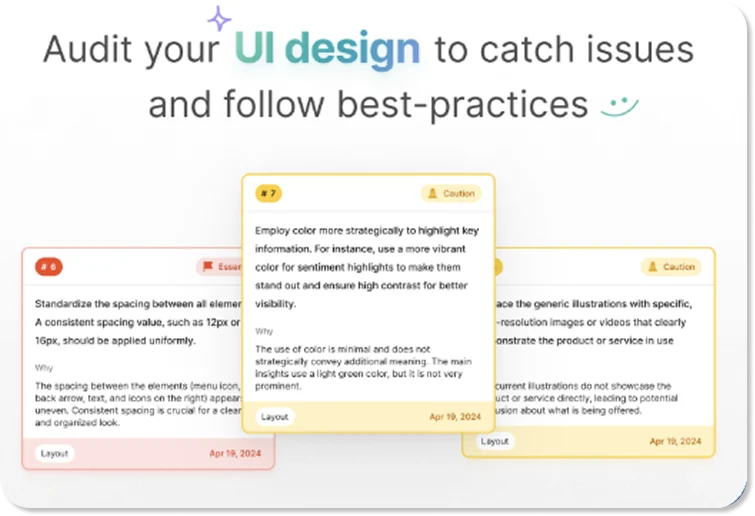
UX Critique
The UX critique layer runs on Claude Opus. It evaluates user flows and design decisions against established UX, cognitive psychology, and human-computer interaction principles, holding context across a full design system rather than responding to isolated elements. The output is the kind of structured, reasoned critique that previously required a senior designer and a synchronous review session. It is now available on demand, consistently, at any scale.
UX Critique & Onboarding AuditTest designs using 130+ psychology principles - and uncover actionable UX and Growth insights
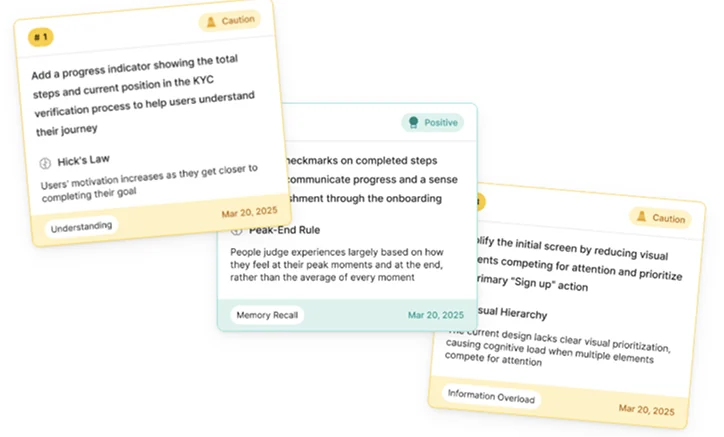
Prototype Generation
After surfacing findings, the platform uses Claude Opus to generate design variants and visual prototypes showing teams exactly what a recommended change would look like applied to their actual design. A finding about visual hierarchy is easy to dismiss. A Claude-generated prototype showing the corrected layout, in context, applied to the team's actual work is not.
For simpler pipeline tasks such as restructuring outputs and formatting analysis for the front end, the platform uses Claude Sonnet, where the task does not require the same reasoning depth and a lighter model performs well. The team’s approach to model selection is to find the model best suited to the job and re-evaluate as new versions ship. As Anthropic models have raised the ceiling on reasoning and image understanding, Claude’s role in the pipeline has grown. The roadmap includes expanding Claude’s role across additional analytically demanding workloads within the system.
It specializes in content clarity, accessibility, and mobile responsiveness.
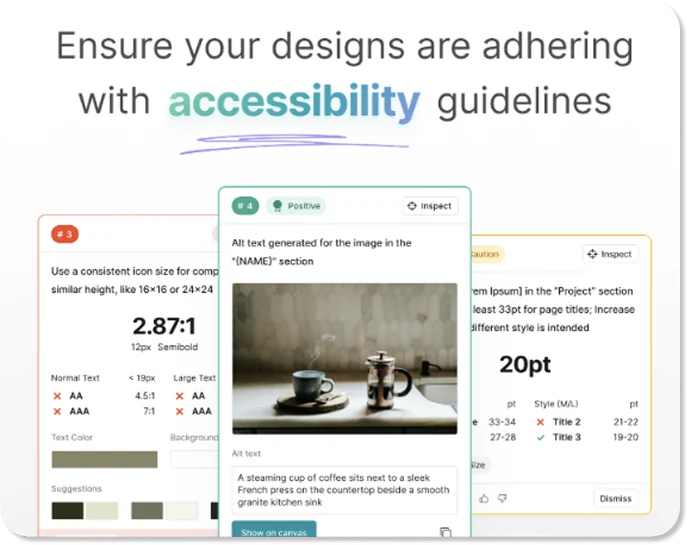
Impact for client
Two years in production and in use by design teams at some of the world's largest organizations
onBeacon has been in sustained production for two years. Design teams at global organizations including ByteDance, Salesforce, Siemens, Dubai Govtech Agency, and Singapore Govtech use the platform. AI recommendations have been implemented in live product roadmaps and active sprints.
- 19,000+ product/design users acquired organically
- 30% month-over-month growth in signups
- Time from design insight to implementation reduced from weeks to minutes
- $1.3M pre-seed raised, with the platform as the core proof point
- AI-generated design recommendations implemented in live product roadmaps and sprints
The design review process that once required a room full of people, a shared screen, and a week of follow-up now runs in minutes. Findings are grounded in principles, prototypes are ready to act on, and the output is consistent regardless of who is doing the reviewing.
Home / Case Studies / Cryptocurrency exchange
Asset Integration for a Leading Cryptocurrency Exchange Platform
Accelerating asset enablement through Rosetta API expertise
Business Problem
Accelerate asset enablement by bringing in specialists to work with Rosetta API specifications and quickly integrate assets with their ecosystem.
Output by Tintash
Delivered Rosetta implementations for assets, Rosetta validations, and asset integrations to speed up the client’s asset integration efforts.
Impact for Client
Beyond delivering integrations, Tintash trained the client's internal teams, optimized asset onboarding, and helped build a high-performing squad across North America to sustain long-term growth.
Client’s brief background and business problem
This US-incorporated client was one of the largest and most compliant asset exchanges in the country. They were looking to onboard specialists who could help support and speed up their asset integration efforts.
Although this client operated on a remote-first model, there were really very few locations outside of the US, Canada, and Europe from where they allowed their team to work from. However, they were in the hunt of a very specific skill set – expertise in Rosetta API specifications. Left with few team members who fully understood how Rosetta worked, the client engaged Tintash given our deep expertise in this area to help eliminate this resource bottleneck.
How did Tintash deliver?
It took Tintash almost three months to get all the required security clearances and access to the client’s systems and machines. Once we started, our team surprised everyone by delivering a complete Rosetta implementation in a mere three weeks. We also helped enable an asset in the quickest ever time in the client’s entire experience of asset integrations.
If our first rosetta implementation showcased our technical ability, our first integration highlighted our capacity to collaborate with multiple teams and stakeholders while keeping everyone focused on the common goal. Positively surprised by our team’s performance, the client handed over the complete asset integration to us.
Our team did not just go above and beyond to deliver the complete end-to-end integration, we did so while also training the client’s engineers. We also interfaced with at least a dozen asset issuers and helped them resolve issues in their Rosetta implementations for a smoother integration.
The third challenge was validating the Rosetta implementations built by the asset issuers for their respective blockchains while also working closely with them to sort out the issues in those implementations. Rosetta being open source doesn’t dictate a lot of those things to be required. However, since we had worked on a complete end-to-end integration, our team foresaw those issues and got them resolved before the actual integration kicked off. This helped further speed up the integration process.
At that point, the client’s executive and product team started looking up to us to drive the optimization efforts in the asset integration pipeline. Our team conducted the root cause analysis and identified Rosetta completeness as still being the biggest bottleneck.
For the next couple of months, we worked closely with the product team to further solidify the Rosetta specifications, which were internal to our client, and effectively share them with all the new assets we were validating and integrating.
How did the final product look?
To summarize, our first Rosetta implementation in a mere three weeks was very well received and unlocked opportunities for us to work on the E2E Asset Integration of numerous assets. Our team also worked closely with the asset issuers to provide them a smooth onboarding experience while getting them to deliver on our requirements.
At the time of this writing (Q1 '23), Tintash continued to be the only team contracted by the client to work as an integral part in their asset integration. Our team members were all working on different assets with the client engineers to provide their expertise and help speed up the multiple asset additions.
Another noteworthy contribution was our team’s squad-building efforts for the client. We got the mandate to build a squad in the US and Canada. We not only recruited and trained IC5 and IC4 engineers across North America but also successfully onboarded them on our client platforms and systems to deliver yet more value to the client.
Home / Case Studies / CLARA
Formal Verification and AI-Powered Auditing
Enhancing Clarity smart contract security for the Stacks ecosystem
Client | CLARA
Business Problem
Develop a faster, more reliable, and comprehensive Clarity smart contract security solution to replace the traditional manual auditing which is time-consuming, expensive, and prone to human error.
Output by Tintash
Built Clara, a Formal Verification engine powered by an AI Audit Agent that automates generation and verification of formal properties and invariants to test business logic and to verify security vulnerabilities.
Impact for Client
Enhanced security through early detection of vulnerabilities, reducing reliance on costly manual audits and accelerating time-to-market by generating instant reports that reduce audit time from weeks to minutes.
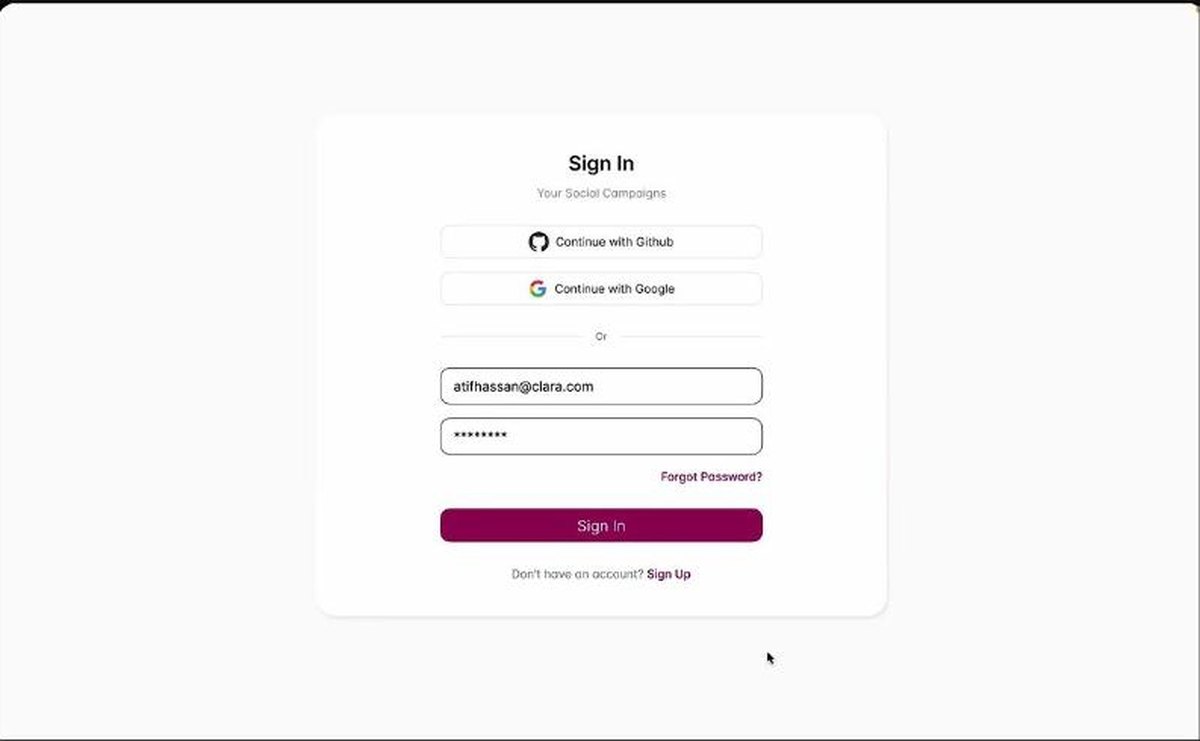
Client's business problem
The immutable nature of deployed smart contracts creates a critical security concern, as post-deployment vulnerabilities are typically irreversible, leading to substantial financial and reputational damage. As the ecosystem matures, escalating complexity increases the risk of exploits.
Traditional auditing processes involve manual review by consultants, which can take weeks or even months, delaying project timelines. Existing static analysis tools, though efficient, frequently fail to detect vulnerabilities stemming from complex business logic. Organizations need an automated, intelligent system that accelerates audits, reduces human error, and provides deeper insights beyond static code scanning.
Clara wanted to solve this problem for the Stacks ecosystem by building a tool that could comprehensively analyze Clarity smart contract logic, provide actionable insights, and integrate seamlessly into existing workflows without disrupting the development speed.
How did Tintash deliver?
Tintash designed Clara, a formal verification engine powered by an AI audit agent that performs deep static and dynamic analysis to detect vulnerabilities beyond surface-level scanning. The development team faced several challenges, including the need to train AI models specifically for Clarity, the smart contract language for the Stacks blockchain. Unlike Solidity-focused tools, Clara had to understand and adapt to Clarity's unique nature - Turing-incomplete and decidable among other characteristics - to avoid false positives and improve detection accuracy.
Team Achievements:
- Developed a multi-agent AI audit system capable of modeling vulnerabilities based on real-world attack patterns.
- Overcame bias in existing LLMs by finetuning AI models with Clarity-focused datasets to ensure accurate vulnerability detection.
- Implemented formal verification techniques that mathematically prove the correctness of smart contracts, providing stronger security assurances compared to traditional fuzzing techniques.
- Designed an intuitive workflow that allows developers to upload contracts via GitHub or direct file submission and receive detailed security assessments within minutes.
- Clara delivers a fully automated, end-to-end contract audit - no manual steps required. Simply upload a smart contract or connect your code repository, and the platform generates a comprehensive final audit report highlighting vulnerabilities and compliance insights.
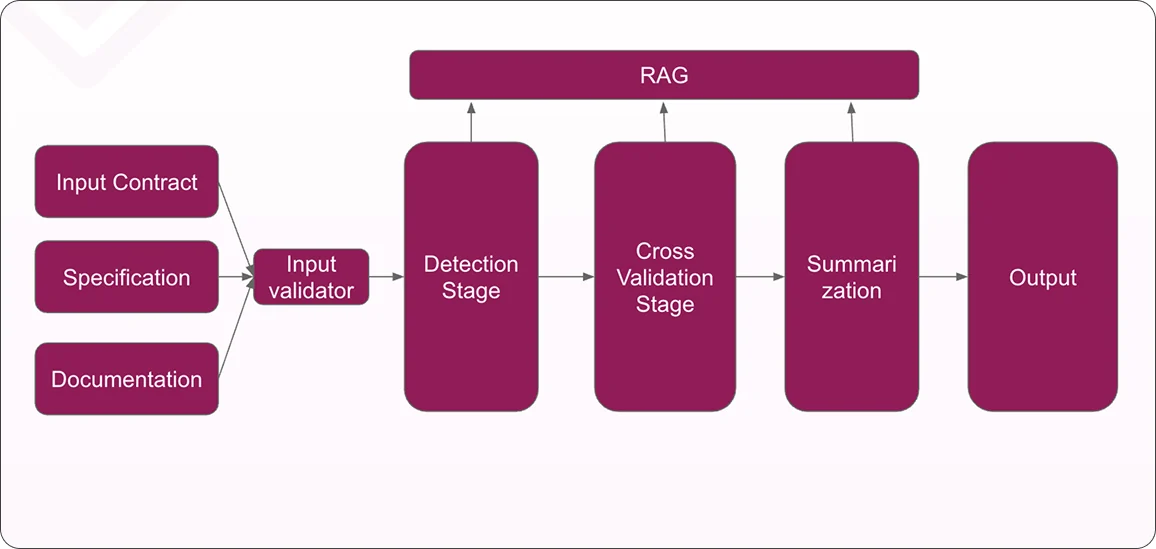
Clara overview diagram
The biggest challenge was ensuring that Clara could go beyond static code analysis to detect business logic errors and systematically uncover security vulnerabilities, which often remain undetected by conventional tools. Our team developed an AI-powered machine-aided remediation engine that not only flags security vulnerabilities but also suggests fixes based on best practices, reducing developers' burden in securing their code.
Code Recommendations:Clara pinpoints code segments requiring attention and provides recommended fixes that adhere to industry standards.
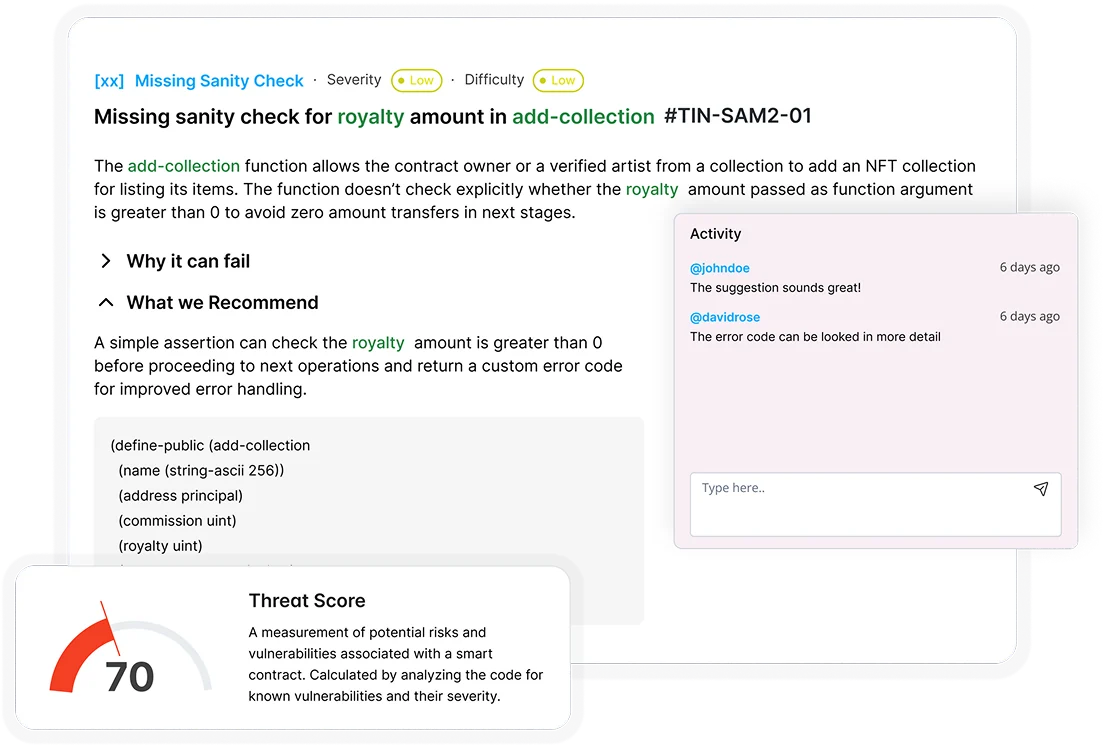
How did the final product look?
Clara is a web-based AI audit platform that provides a streamlined, developer-friendly interface for smart contract security assessments. The dashboard presents key security metrics such as threat scores and vulnerability categorization, enabling quick risk assessment. The tool generates detailed vulnerability reports, offering precise explanations and mitigation strategies. Clara's formal verification outputs validate smart contract correctness with machine-assisted reasoning through mathematical theorem proofing, ensuring higher reliability. Its integration capabilities allow developers to use it within future GitHub Actions, CLI environments, and Visual Studio Code extensions, making security auditing a seamless part of their workflow.
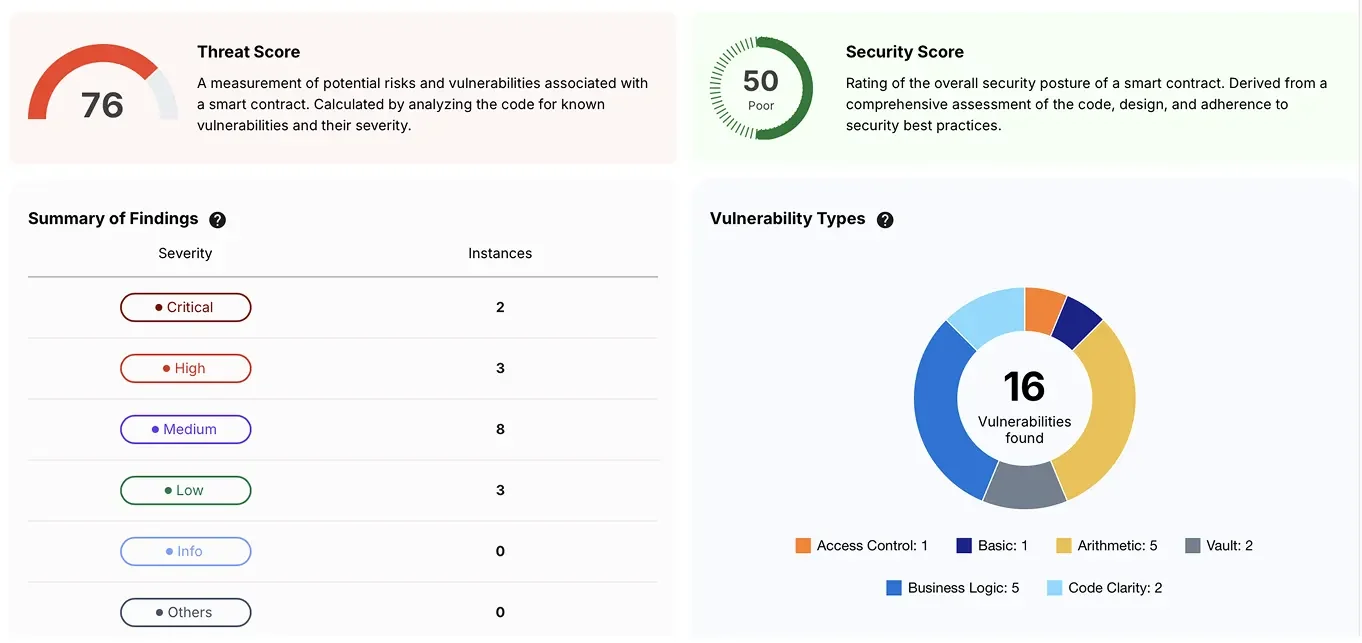
Comprehensive Audit Output
The fact that the audit engine is continuously being updated, based on the industry security benchmarks, ensures the audit engine stays current, identifying both known and emerging vulnerabilities. This allows Clara clients to deploy contracts faster with enhanced security confidence. By enabling developers to catch security flaws early, accelerate smart contract deployment, and ensure a higher level of trust and security in decentralized applications, Clara is redefining how blockchain projects approach security audits.
Home / Case Studies / Above Data
Turning Analyst-Led Audience Creation Into Signal Infrastructure for Enterprise Marketers
Built a fundraising-ready platform that transformed analyst-led workflows into signal-based audience creation and helped secure seven figures in sales.
Client | Above Data
Business Problem
Above Data needed a fundraising-ready MVP that could turn multi-day, analyst-led audience creation into a self-serve product while proving enterprise-scale, multi-tenant SaaS readiness to investors and early customers.
Output by Tintash
Tintash designed and built signal-based infrastructure platform with conversational workflows, interactive data visualization, direct ad-platform delivery, and enterprise-grade cloud infrastructure from prototype to production.
Impact for Client
Turned an investor-ready MVP into seven figures in sales, replaced deck-driven fundraising with a live product experience, and created a scalable foundation for enterprise pilots and post-raise growth.
We used the demo built by Tintash to secure seven figures in sales in the following quarter.
We launched our MVP on time and now have a UI framework for the rest of our platform. We also have a working UI with an AI agent that we're continuing to train and improve.
They leaned in early, were nimble, and could iterate quickly on plans. Their deep integration into our team and business to act like part of the team was unique.
Client background and business problem
Above Data was an early-stage signal infrastructure platform with a strong thesis: marketing and CPG brand teams should be able to build, refine, and activate signal-based audiences from live, deterministic signal without depending on data engineers, SQL queries, or week-long analyst turnarounds.
To validate that thesis with investors and prospective enterprise customers, they needed a working MVP they could put in front of a fundraising audience. Not a clickable prototype or a deck, but a real, multi-tenant product that a live user could drive end-to-end against real consumer data.
The MVP had to be:
- Polished enough to anchor the fundraising story
- Technically credible enough to survive due diligence
- Architecturally sound enough to support the company through its first enterprise customers post-raise
Their target customers, marketing teams at retailers and CPG brands, had access to valuable first-party and panel data, but no intuitive way to interact with it.
Building a targeted audience typically required:
- Filing a ticket with a data engineer
- Waiting for a SQL-driven extract
- Iterating over email
- Manually loading the resulting list into ad platforms
The cycle could take days, limiting campaign agility and restricting the product to a small group of analysts. Above Data approached Tintash with a clear ambition: build a fundraising-ready MVP that rebuilt the audience-building experience as a conversational, AI-native product any marketer could use.
Key discovery questions included:
- How do users describe an audience in plain English while still ending up with a precise, deterministic signal definition that ad platforms can ingest?
- How do we present millions of consumer records in a way that is digestible, interactive, and actually guides the user toward a high-quality audience?
- How do we keep the AI co-pilot grounded in real data and not hallucinated numbers?
- How do we ship this as a true multi-tenant SaaS product with enterprise-grade authentication from day one?
- How do we close the loop by delivering audiences directly to Facebook, Google, and other destinations without CSV exports?
- How do we do all of this on an investor-driven timeline with the polish and reliability needed for live fundraising demos?
How did Tintash deliver?
Tintash designed and built the Above Data MVP end-to-end, creating a fundraising-ready, multi-tenant platform that turned analyst-led signal-based audience creation into a self-serve product for enterprise marketers.
Tintash owned the full product stack:
- Product design and Figma prototyping
- Next.js frontend development
- Agentic AI product development
- Python AI agent backend
- Data and delivery integrations
- Google Cloud Platform infrastructure
Rather than splitting the project across multiple vendors, Above Data partnered with a single team that owned the product from the first design prototype to production deployment.
1. Figma Prototype of the Full Experience
Before a single line of production code was written, Tintash designed the complete audience-builder experience in Figma, including:
- Landing page
- Conversational chat
- Interactive charts
- Live Audience Ingredients sidebar
- Dashboard
- Audience detail page
- Four-step delivery wizard
The prototype became both:
- A fundraising asset for investor and design-partner conversations
- The engineering source of truth that kept MVP scope tight and timelines on track
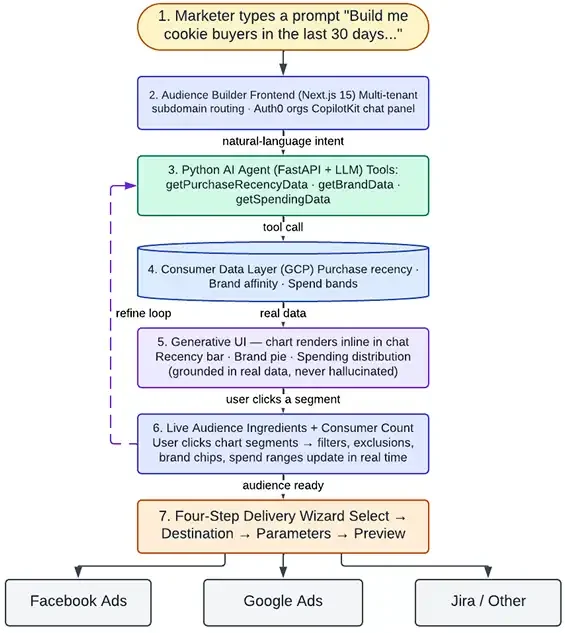
System flowEnd-to-end flow of the AI Audience Builder
2. Conversational AI Audience Builder
Tintash built an AI-native Audience Builder where marketers describe an audience in natural language and an embedded AI co-pilot guides them through the segmentation process.
The architecture was designed as a two-tier system:
Python agent backend
Exposed deterministic data tools such as:
- Purchase recency data
- Brand affinity data
- Spending distribution data
Frontend generative UI
- Purchase recency distributions
- Brand breakdowns
- Spending charts
This ensured the AI could never invent numbers, because every chart was grounded in real consumer data pulled from the backend.
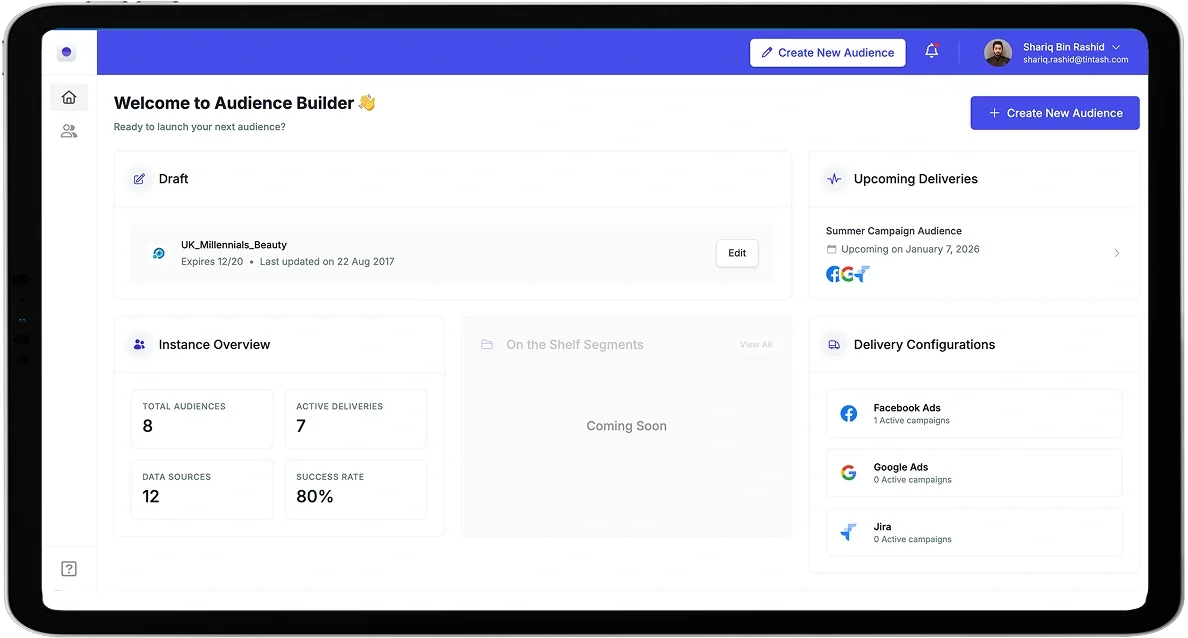
Dashboard - “Welcome to Audience Builder”
3. Click-to-Refine Audience Ingredients
Every AI-generated chart is interactive.
Clicking a recency band, brand, or spending range:
- Adds the selection to a structured Audience Ingredients panel
- Updates the live consumer count in real time
- Creates a deterministic and auditable audience definition
This gave marketers complete visibility into exactly how an audience was being built.
4. Multi-Tenant SaaS Architecture
Above Data needed a credible path to enterprise revenue.
Tintash built:
- Subdomain-based tenant routing
- Organization-aware authentication
- Secure multi-tenant data architecture
- Enterprise-grade cloud infrastructure
Tintash also owned:
- Cloud environment setup
- Identity and access controls
- Storage and networking architecture
- Deployment pipelines
- Environment templates
New enterprise tenants can now be onboarded through configuration instead of engineering cycles.
5. Audience Detail & Insights Experience
Tintash built a dedicated audience detail experience showing:
- Audience size
- Estimated CPM
- Time window
- Audience trend charts
- AI-generated summaries
- Full ingredient breakdown
This gave marketing, finance, and compliance stakeholders a single shareable view of every audience.
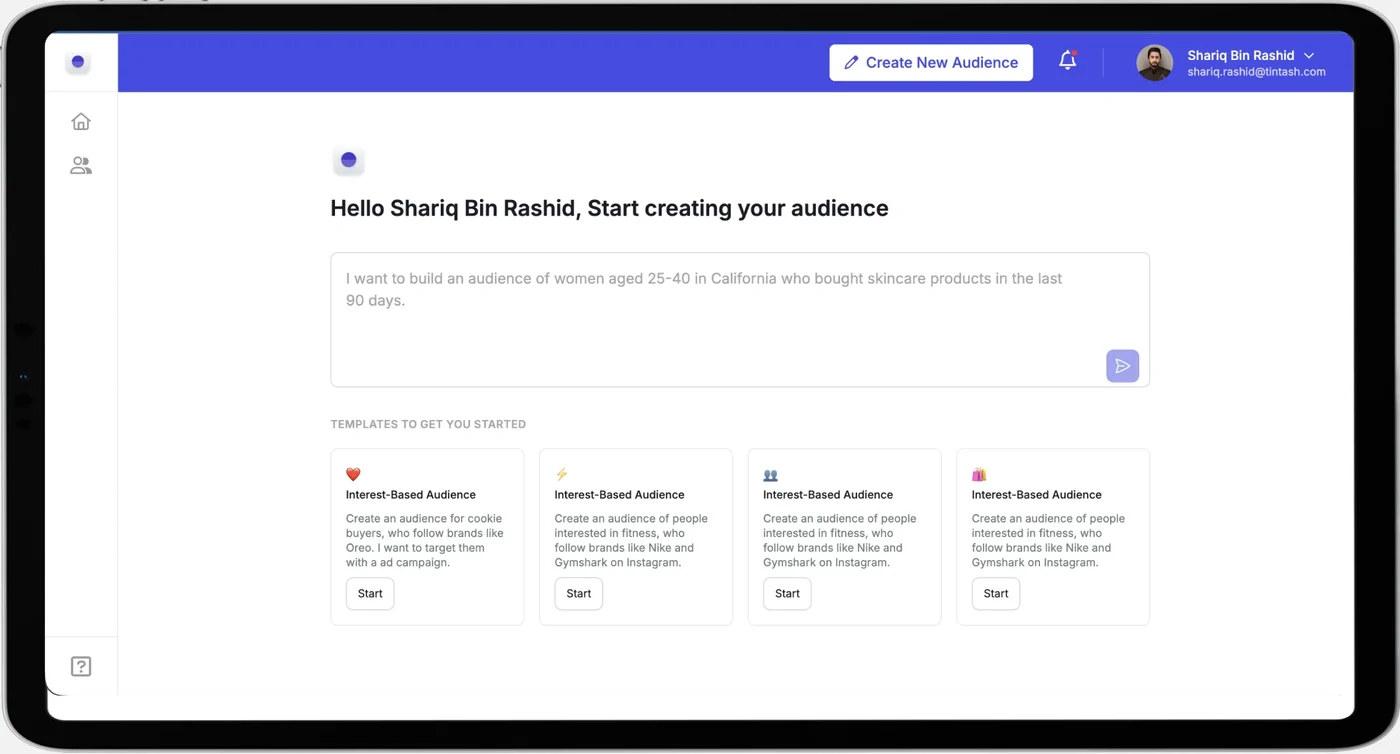
Audience creation landing“Start creating your audience”
6. Four-Step Delivery Wizard
Building an audience was only half the workflow. Activation was the other half.
Tintash designed and built a guided delivery flow:
Select Audience → Destination → Parameters → Preview
Audiences can now be pushed directly to:
- Facebook Ads
- Google Ads
- Other destinations
With:
- Audience summaries
- Match-rate visibility
- Delivery validation
This removed the need for CSV exports and manual uploads.
What the final product looked like
The final MVP became a polished, AI-native marketing product that Above Data can demo live during investor and enterprise conversations.
The platform delivers:
- A personalized dashboard experience
- Draft audiences that can be resumed
- Audience insights and forecasting
- Upcoming delivery schedules
- End-to-end audience creation and activation
- Per-tenant enterprise environments that can be provisioned without re-architecting the platform
Impact for client
Fundraising Ready
A real, working, multi-tenant MVP replaced a deck-and-prototype fundraising narrative, and the demo built by Tintash helped Above Data secure seven figures in sales in the following quarter.
From Days to Minutes
Audience creation shifted from multi-day, analyst-led SQL and CSV workflows to a self-serve conversational experience completed in a single sitting with zero engineering involvement.
Expanded User Adoption
Audience-building moved beyond a small analyst team to the broader marketing function across each customer organization.
Unified Data Access
Multiple deterministic signal sources are now accessible through a single conversational interface, with the AI selecting the right data source and grounding every chart in real data.
Enterprise Ready
Early design partners and enterprise pilots can now be onboarded through configuration rather than engineering cycles.
Closed Activation Loop
Audiences are pushed directly to Facebook Ads, Google Ads, and other destinations from inside the same product where they are created.
Home / Our Approach / Engagement model
Embedded teams that turn business ambition into automation you own
We embed forward-deployed teams of business analysts, data specialists and engineers into your operations.
Five stages
At each gate you decide whether to continue
Budget is committed one stage at a time. Discover, Prove and Scale repeat for each new workflow, and every stage runs within your security, governance and compliance rules.
- 01AlignGoal, success measures and scope agreed.
- 02DiscoverIdeas found, scored and ranked with you.Gate: first proof
- 03ProveA first version in users’ hands.Gate: scale-up
- 04ScaleMore workflows live, quarter by quarter.Gate: each quarter
- 05HandoffYour team runs and extends it.
Discover
Typically 2 to 4 weeks for the first DiscoveryDeciding what to build
Business discovery: what to automate and why, guided by the goals agreed in Align.
- DiscoverInterviews with every team involved
- DefineMap the process and group pain points
- IdeatePropose solutions for each pain point
- PrioritizeScore each solution; you choose what to build
Every solution is scored with you on five criteria
Adapted from RICE, plus measurability.
RelevanceDoes it move a success measure?
ImpactTime, cost or risk it removes
ConfidenceHow sure we are it will work
EffortWhat it takes to build and run
MeasurabilityCan the gain be proven with data?
Discovery is led by a business solutions lead, a technical solutions lead and a data specialist; engineers join when we build.
Prove and Scale
Build and iterate. No automation is perfect on day one.
This runs first in Prove, then for each new workflow in Scale. Each version is released, measured and refined until it works in practice.
- 01Technical feasibilityCheck knock-on effects on connected systems and SOPs.
- 02BuildIn your own tools, data and repositories.
- 03ReleaseA first version in users’ hands, fast.
- 04MeasureTrack results against the agreed success measures.
- 05IterateRefine with real use, then release again.
- 06Embed in operationsWe run new tech and SOPs alongside your team.
Weekly operations callsOnce automation changes daily work.
New SOPsWritten alongside the automation.
Documented as we goNot dumped at the end.
Handoff
Your team runs and extends it
Systems, code and new SOPs are yours from the first commit. At the Supplier Readiness client, handoff meant 20+ turnover sessions, all code in the client’s own repositories, and a system the client’s own team has since extended.
What we need from you
Executive sponsorOwns the business goal and decides at each stage.
Senior internal championUsually reports to the sponsor; arranges access and unblocks decisions.
Access to your peopleTime with the people who do the work today.
Start with an intro call.
Book a call with MannanHome / Case Studies / Case study
EQT-backed supply-chain compliance SaaS company
AI Workflow Automation
Supplier Readiness program, 2025–26
10x Supplier Readiness Capacity on ~3x Staffing
Without automation, the team would have grown with supplier volume. The automation was funded from the hiring budget.
Results
10×more suppliers handled, vs ~3× growth in the team
89%strategic suppliers compliant, against a 95% target (up from 65%)
25%of cases closed automatically, with no team touch
1 qtrearly on the year’s client onboarding target
Context
The client’s largest customer set a 95% target for compliant suppliers, and the obvious answer was to hire more people.
GoalThe executive sponsor, the Chief Customer Officer, wanted to meet it without headcount growing at the same rate.
Align set six success measures, such as touches per supplier, time to compliance and manual reporting effort.
Six automated workflows and their impact
- Customer segmentation and proactive automated case creation
- Campaign setup cut from days to minutes
- Case prioritization and routing
- Routed across 5 regional teams
- Supplier compliance profile built on a certified data product
- 53% less time looking up a supplier’s compliance
- Follow-up scheduling and assisted email preparation
- 71% less email preparation time
- Configurable client onboarding
- Full-year onboarding target met a quarter early
- Automatic case closure
- 25% of cases closed with no team touch
Other outcomes
What changed for the team
Figures refer to the client’s Supplier Readiness team and program; strategic-supplier compliance started at 65%.
- 10 times more suppliers handled, against ~3 times growth in the team
- 89% of strategic suppliers compliant, against a 95% target
- Compliance data product accepted against the client’s Data Management Group standards
- Handoff: 20+ turnover sessions, all code in the client’s own repositories, since extended by the client’s own team
In the client’s words
Have a program like this one?
Book a call with MannanHome / Company / About
About Us
Built by engineers who ship, since 2008
Tintash is a tech services firm focused on Enterprise AI, backed by deep product and engineering experience.
Trained at the d.school, wired to prototype
Two Stanford alumni met over breakfast at Hobee’s in Palo Alto in 2008 and decided the best way to learn what works is to build it. They wanted to create opportunities for talented professionals in their home country, and they built the firm around experimentation rather than specification. Design thinking and lean-startup method applied to client work, not just to internal decks.
Eighteen years later that instinct is the reason forward-deployed engineering works for us: we would rather run a scoped pilot inside a live workflow than write a strategy document about it. We start most relationships with a small project, relationship prototyping, because the fastest way to know whether two teams work well together is to ship something small together first.
Our teams are deliberately balanced and diverse, organized around product vision and impact rather than billable-hours utilization. We run our own performance platform to keep that honest.
Building across technology cycles
From early-stage products to scaled platforms
Over the next 18 years, Tintash worked across different stages of company and product development, from helping founders take ideas from zero to one to building and scaling products for unicorns and enterprise environments.
The technologies and industries changed. The underlying work remained product building: understanding users, navigating ambiguity, shipping working software and improving it through real-world feedback.
Top-10 Megafundbacked portfolio company
Leading UScrypto exchange
4 Fortune 500sserved
12 unicornsand 170+ startups
The five values at the heart of our work
Have faithCommit to the hard version of the problem before you can see the whole path.
Be proactiveSurface the issue before it becomes a status update.
AkhlaqCharacter and conduct. How we treat people when the project is under pressure.
PrototypeBuild the smallest real thing rather than argue about the abstraction.
ShokuninThe craftsman’s obligation to the work itself, independent of who is watching.
90.7%Net promoter score
98%Employee retention
18 yrsBuilding products
5Countries
TealOperating model
Leadership & advisors
Home / Company / Journey
Our Journey
18 Years of Product Building
Founded by Stanford alumni in 2008, Tintash has built products across startup, unicorn and enterprise environments.
That experience now powers our focus on Enterprise AI for PE-backed companies.
From a breakfast table to five countries
Eighteen years on, the through-line is unchanged: build the smallest real thing, put it in front of the people who have to use it, and let the evidence decide what happens next.
2008
Founded at Hobee’s, Palo Alto
Two Stanford alumni, d.school-trained, start a firm built on prototyping rather than specification.
2012
Studios take shape
Practice areas form around apps, games and emerging platforms, the range that later feeds the enterprise work.
2018
Scale clients arrive
Fortune 500 programs and unicorn-stage engagements: AR commerce, mass transit, superapp re-architecture.
2021
Protocol engineering
On-chain systems where correctness is not negotiable: oracles, exchange integrations, contract audits.
2024
Forward-deployed AI
Engineers embed inside client workflows. Workflow–User Fit becomes the operating principle.
2026
Enterprise AI practice
Document verification, workflow automation and certified data products inside PE-backed portfolio companies.
Product-building journey before 2024
Before Enterprise AI became our primary focus, Tintash built across three specialist practices.
Zero-to-One
Ideas to launched and scaled products.
170+Startups served
12Unicorns
2 moTypical MVP


Games & Interactive
Games and interactive experiences built for scale.
50M+Downloads
#3US App Store peak
4.9★Player ratings


Web3
Blockchain products, protocols and infrastructure.
$25KBug caught in 6 min
6Protocol clients
24/7Oracle uptime


2024 onward
Enterprise AI Became Our Primary Focus
By 2024, the product-building discipline developed over years of working across startup, unicorn and enterprise environments had become the foundation for Tintash’s next chapter.
As AI moved from experimentation into real operational workflows, we brought that same approach to Enterprise AI: understand the problem, work closely with users, validate quickly and scale what creates measurable value.
Today, our forward-deployed engineers embed with client teams to turn leadership’s AI hunches into validated opportunities and working systems.
Home / Privacy Policy
Privacy Policy
Last Updated: June 2026
At Tintash, your privacy is very important to us. Accordingly, we have prepared this Policy in order for you to understand how we collect, communicate, disclose and make use of personal information. The following outlines our privacy policy.
The summary text, where it appears, provides a plain English version of the topics covered in this policy. Please do read the entire text, as the summary doesn’t capture all details.
Thank you for visiting our website.
Tintash is an emerging-tech services company that provides offshore component and co-located tech & product leadership. We work closely with you to design and build your digital products. Through our website we aim to provide you with clear and well organized information about our services. We want to make it easy for you to understand what we do and how to reach us.
This privacy policy explains what personal data is collected from you while you use the Tintash website, how we use it, and how you can exercise meaningful control over it. While you are here, we collect some personal information such as the device that you are using and your IP address. In addition, you may choose to provide information such as your name, email address, location and phone number through our ‘contact us’ form if you want to get in touch with us to begin a dialogue about working together.
Summary: We collect limited personal information with the purpose of improving your experience on our website. Most of this information is provided by you directly through our contact form if you choose to do so.
Tintash is the controller for the processing of your personal data when you use our services, in accordance with this privacy policy. As a data controller, Tintash is responsible for determining why and how your personal data is processed and is also responsible for complying with data protection legislation.
Summary: You can contact Tintash regarding the processing of your personal data by reaching us at the contact information provided at the end of this policy.
Webserver Statistics
Tintash website collects data for analytics and user journey improvements. This is based on statistics regarding the visits to the website. This information helps enhance the overall experience you have while using the website. All of this statistical information is anonymous and we cannot identify a person based on this unless a person signs up and provides their personal information on the website.
Telephone Inquiries
When you opt to reach us via telephone, the number might be stored. This is used by our client engagement team to follow up and communicate with you in order to understand your requirements and needs better.
Signup Form
Sign up form is used to collect basic information that you enter directly, for our sales team to be able to contact you and learn a little about the solution and services that you are looking for. This form asks for your full name, email address, phone number, country, and project description.
Your personal information like name and phone number is used by our team to reach out to you to facilitate getting a quote/obtaining our services. Some of this information is also needed for signing legal contracts and NDAs. A description of the project helps us understand the business problem that requires our assistance, and how to align our resources in the most efficient way possible to facilitate the clients’ journey with us. This information is sent to our CRM to ensure a smooth client journey.
Third Party Service Providers
Tintash uses third parties and vendors (“Third Party Service Providers”) to process data on our behalf under appropriate agreements.
This includes third party services to maintain and improve the website’s content. Through these service providers we process personal data to understand user interaction with our website and to obtain contact details where users provide it directly through our contact form. The list of these third party service providers and the product or service being used is as follows:
List of Third Party Service Providers
| Third Party Service Provider | Product/Service | Link to Privacy Policy |
|---|---|---|
| Google Ads | Google Search Ads | https://business.safety.google/adsprocessorterms/ |
| Paperform | Embedded Sign up form | https://paperform.co/privacy/ |
| Google Workspace | Email and Google sheets | https://policies.google.com/privacy?hl=en |
| Pipedrive | CRM | https://www.pipedrive.com/en/privacy |
| Make | Automation tool to link forms with CRM | https://www.make.com/en/privacy-notice?fromImt=1& |
| HelloSign | Contract signing | https://www.hellosign.com/privacy |
| Google Analytics | Anonymous analytics and attribution information | https://policies.google.com/privacy?hl=en-US |
| Hotjar | Anonymous user interaction heatmaps | https://www.hotjar.com/privacy/ |
How Your Information May Be Used
We use the information solely for fulfilling the purposes specified by us and for other compatible purposes.
Tintash may share personal data with Third Party Service Providers to perform tasks on behalf of and under our instructions such as technical support, client education, billing, analytics, and communication.
We will not distribute or share your personal information with third parties without your knowledge and consent, except under the following circumstances: (a) If you use an account or profile associated with another party, we may share your information with the owners of that profile (for example, if you are an employee using your organization’s account or profile to communicate with us regarding our site and/or services); (b) With our corporate family of companies that are related by common ownership or control, to enable us to provide (or support us in providing) our services; (c) If Tintash is acquired by or merged with another company (in this event, Tintash will use reasonable efforts to notify you before information about you is transferred and becomes subject to a different privacy policy); (d) With Third Party Service Providers of Tintash to perform tasks on behalf of and under our instructions; (e) In response to subpoenas, court orders, or legal process, or to establish or exercise our rights to defend against legal claims; (f) If we believe it is necessary to investigate, prevent, or take action regarding illegal activities, suspected fraud, safety of person or property, or as otherwise required by law; (g) For any purpose disclosed by us when you provide the information; or (h) We may also share aggregated information and other anonymized information for regulatory compliance, industry and market analysis, demographic profiling, marketing and advertising, and other business purposes.
Data Subject Rights
Tintash is committed to ensuring all of your data protection rights are protected. Listed below are the data protection rights that you have, as listed on the gdpr.eu website:
The right to access – You have the right to request Tintash for copies of your personal data.
The right to rectification – You have the right to request that Tintash correct any information you believe is inaccurate. You also have the right to request Tintash to complete the information you believe is incomplete.
The right to erasure – You have the right to request that Tintash erase your personal data, under certain conditions, if the continued processing of that personal information is not justified.
The right to restrict processing – You have the right to request that Tintash restrict the processing of your personal data, under certain conditions.
The right to object to processing – You have the right to object to Tintash’s processing of your personal data, under certain conditions.
The right to data portability – You have the right to request that Tintash transfer the data that we have collected to another organization, or directly to you, under certain conditions.
Storage, Transfer and Security of Data
We will not retain your personal information longer than necessary for the purposes for which it was collected.
Tintash may share personal data with Third Party Service Providers under appropriate agreements whereby they must agree to use such personal data only for the purposes for which they have been engaged by Tintash.
Your personal information may be transferred to, stored, and processed in the United States or a country that is not regarded as providing the same level of protection for personal information as the laws of your home country. We have put in place appropriate safeguards (such as contractual commitments) in accordance with applicable legal requirements to provide adequate protection for your personal information.
The security of your data is important to us, but please do remember that no method of transmission over the Internet or method of electronic storage is 100% secure. While we strive to use commercially acceptable means to protect your personal data, we cannot guarantee its absolute security.
Use of Cookies
Tintash website uses cookies to collect standard Internet log information and visitor behavior information. Cookies are files placed on your browser that record and store this information to recognize your browser every time, and to enhance your user experience. We use the Osano platform for our cookie management.
We use these cookies to keep you signed in and to understand the user journey. This information helps us make the experience more customized for you, and to make improvements in the process.
Types of Cookies Used
Functional - Tintash website uses these cookies to identify you on the website and store your preferences.
Analytics - Tintash website uses these cookies to collect anonymous information regarding how you use the website, as described under the use of Third Party Providers.
Marketing - Marketing cookies are used on the Tintash website to store information of the pages you visit in order to show relevant pages to you. You can choose to enable or disable these cookies by accessing the cookie setting on your browser.
If you want to change your cookie preferences at any time, you can click the cookie icon on the bottom right corner and change the settings you've previously selected. If you would like to delete cookies or instruct your web browser to delete or refuse cookies, you can do so by choosing appropriate browser settings.
For more information on how to manage cookies on some of the major browsers, please see below:
Google Chrome
https://support.google.com/chrome/answer/95647?hl=en
Internet Explorer
https://support.microsoft.com/en-us/help/17442/windows-internet-explorer-delete-manage-cookies
Firefox
https://support.mozilla.org/en-US/kb/cookies-information-websites-store-on-your-computer?
Safari
https://support.apple.com/en-au/guide/safari/sfri11471/
This Privacy Policy does not cover the use of cookies by any third-party links. Tintash will not be liable for the personal privacy policies on these sites. Please be aware that the privacy policies of these websites could vary from our own.
Contact Information
If you have any questions regarding this privacy policy, or how Tintash processes personal data, please do not hesitate to contact us using the following contact information.
Email address:[email protected]
GDPR Representative:
Osano International Compliance Services Limited
ATTN: AE4E
25/28 North Wall Quay
Dublin 1, D01 H104
IRELAND
A Note about Children
We do not intentionally gather personal information from visitors who are under the age of 16. If a child under the age of 16 submits personal information to Tintash and we learn that the personal information is the information of a child under 16, we will attempt to delete the information as soon as possible. If you believe that we might have any personal information from a child under 16, please contact us at: [email protected].
This privacy policy was last updated in June 2026. We may update our privacy policy from time to time. You are advised to review this Privacy Policy periodically for any changes. Changes to this Privacy Policy are effective when they are posted on this page.
Home / Fraud Disclaimer
Fraud Disclaimer
Last Updated: 31st of March, 2023
At Tintash, your privacy is very important to us. Please note that we only communicate through our official website. Any other website or entity claiming to represent us may be fraudulent.
It has come to our attention that certain organizations and individuals misrepresenting themselves as agents, officers, or members of Tintash Inc., may approach you and attempt to obtain your personal or financial information by offering fraudulent financing or investment opportunities, services, products, or prizes. This fraud may be perpetuated via an unsolicited email, an online message, a pre-recorded telephone message, or by using a website or social media account that purports to be affiliated with Tintash Inc. These claims and offers are fraudulent and invalid, and you are strongly advised to exercise great caution and disregard such offers and invitations.
Tintash does not contact individuals via automated or prerecorded telephone calls, nor do we contact individuals via generic email addresses such as Gmail, Hotmail, or Yahoo. All communications will always originate from a verifiable Tintash source, telephone number, or e-mail address and not from any free web-based pages or email accounts. Additionally, Tintash does not use platforms such as WhatsApp, Telegram or other instant messaging applications to reach out to potential clients or employees. Please take extra caution while examining such web-based pages or email addresses, as the perpetrators may misspell an official Tintash page or email address and use a slightly modified version of an official Tintash email address or the Tintash official web page.
Criminal and/or civil liabilities may arise from such actions and we intend to cooperate with competent law enforcement agencies and to ask them to take appropriate action whenever such phenomena occur. If you are unsure whether a communication is legitimate, please send us an email query to [email protected] before taking any action related to such correspondence.
Please note that tintash.com and tintash.no are the only domains representing Tintash. If you receive any correspondence from a similar-looking website or online entity, notify the police or other competent authority and do not share any information with them.
Please note that under no circumstances shall Tintash be held liable or responsible for any claims, losses, damages, expenses, or other inconvenience resulting from or in any way connected to the actions of these imposters.