AI Is Making Software Development Faster. Reliable Change Is the New Bottleneck.
AI is changing how quickly software can be built. Coding assistants have evolved into agents that can generate features, refactor modules, write tests, and take on larger parts of the development lifecycle.
That creates an obvious opportunity for companies that want to move faster. But faster implementation also creates a different challenge: can teams keep changing software quickly without losing confidence in what it does, why it works, or what a future change might break?
That is the distinction between speed and reliable speed. For business leaders, especially at PE-backed companies working against time-bound value-creation plans, faster delivery matters only if the underlying software remains understandable and adaptable as requirements, teams, and ownership change.
When Software Delivery Speeds Up, the Bottleneck Moves
Traditional software development relies on an assumption that becomes more important with AI: the engineer remembers, while Large Language Models do not.
As AI-assisted codebases grow, that gap creates predictable problems. Decisions can disappear between sessions, business rules can remain implicit, changed requirements can leave old behavior behind, and tests can pass without proving the behavior the business intended.
The issue is not whether AI can generate good code. It can. The issue is whether teams can continue making changes at that speed without losing context and confidence.
A March 2026 DORA analysis found that higher AI adoption was associated with both greater delivery throughput and greater delivery instability, while time saved during generation was often reallocated to auditing and verification.
Specifications Become More Valuable as Implementation Gets Easier
As AI takes on more implementation work, the highest-value engineering decisions move upstream.
Our CTO puts it simply:
When implementation becomes inexpensive, specifications become the scarce resource.
The important questions need to be answered before code is generated. What should the system do? What happens at the edges? Which part of the system owns a behavior? What is being changed or replaced? How will the team know the implementation reflects what was intended?
This is the idea behind Spec-Driven Development (SDD). A June 2026 post on Microsoft for Developers describes SDD as a spec-first approach for keeping requirements, design, implementation, and validation aligned as AI accelerates execution.(developer.microsoft.com)
The division of responsibility becomes clearer:
Humans specify. AI implements. Humans review.
The goal is not to keep humans involved in every keystroke. It is to keep them responsible for consequential decisions while AI accelerates execution.
Recent McKinsey research points to the same broad pattern at enterprise scale: teams getting more value from agentic development are pairing faster execution with stronger workflows, verification mechanisms, and clearer human oversight. (mckinsey.com)
Our Approach at Tintash: Human-Guided, AI-Assisted, Traceable Engineering
This is the problem our CTO, Muhammad Ali, set out to address with hGATE: human-Guided, AI-assisted, Traceable Engineering.
hGATE structures specification-driven development around a simple principle: humans own intent and important decisions, AI accelerates implementation, and the path between the two remains traceable and auditable.
It is designed to work incrementally rather than requiring the entire system to be specified upfront. A bounded context, a defined area of business ownership, can be refined, implemented, and verified independently, then extended as requirements evolve.
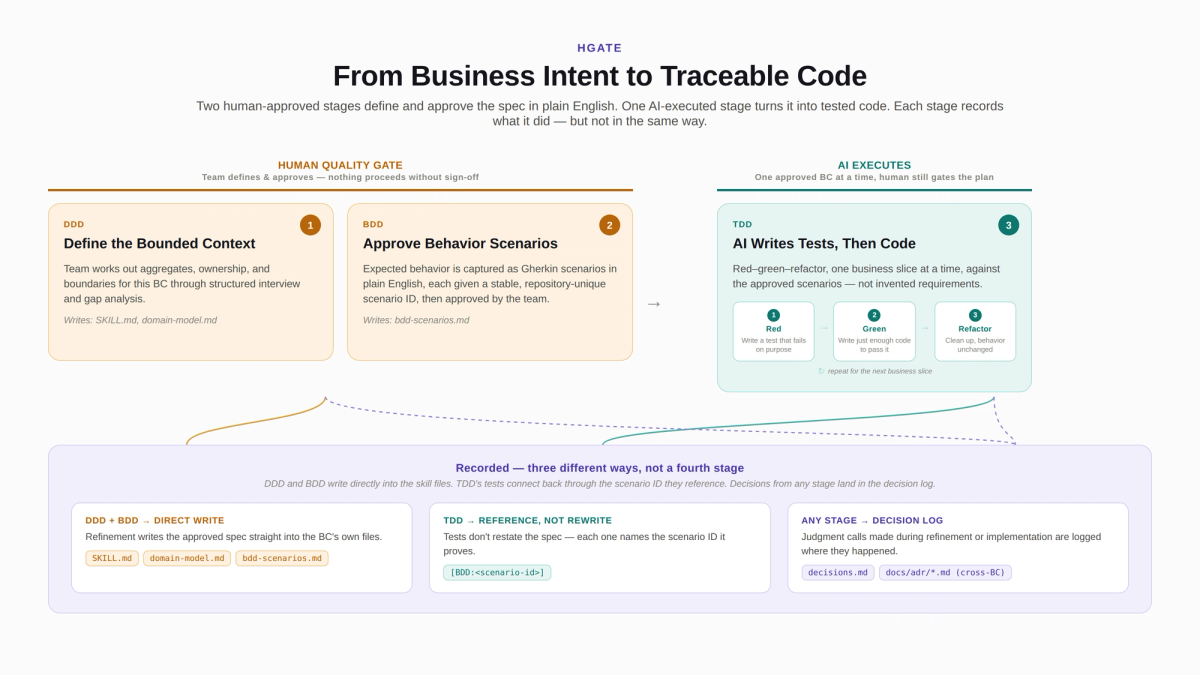
Specifications tell AI what should be built. Traceability preserves the connection between that intent and what eventually ships.
That persistence matters because AI is not the only thing that forgets. Developers change teams, vendors change, and requirements evolve. hGATE is designed so business behavior, engineering decisions, and system context survive beyond a single session instead of being reconstructed from the codebase each time.
What Reliable Speed Means for the Business
For business leaders, the value is not DDD, BDD, TDD, or any other methodology on its own. The value is being able to move faster without making future changes harder.
A spec-driven, traceable development process reduces dependence on tribal knowledge because important behavior and decisions are made explicit. It can also make handoffs cleaner because the next engineer, vendor, or AI session has a clearer record of what the system is expected to do, how that behavior is validated, and why important choices were made.
For PE-backed companies, this matters because engineering work often sits inside a time-bound value-creation plan. Faster delivery can support automation, operating improvements, and new product opportunities, but the speed needs to survive changing requirements, teams, and priorities.
The objective is not simply to maximize AI-generated output. It is to increase the organization's ability to turn business decisions into reliable, explainable software changes.
From Faster Coding to Reliable Speed
AI-assisted software development will continue to get faster. The response is not to slow it down, but to structure the development lifecycle so specifications, human decisions, tests, and implementation stay connected as more execution moves to AI.
That is what hGATE is designed to operationalize at Tintash: human-guided intent, AI-assisted implementation, and traceable engineering.
Ali's closing principle captures the objective best: the goal is to make speed survive the second developer, the third month, and the next requirement change.
That is what we mean by reliable speed.